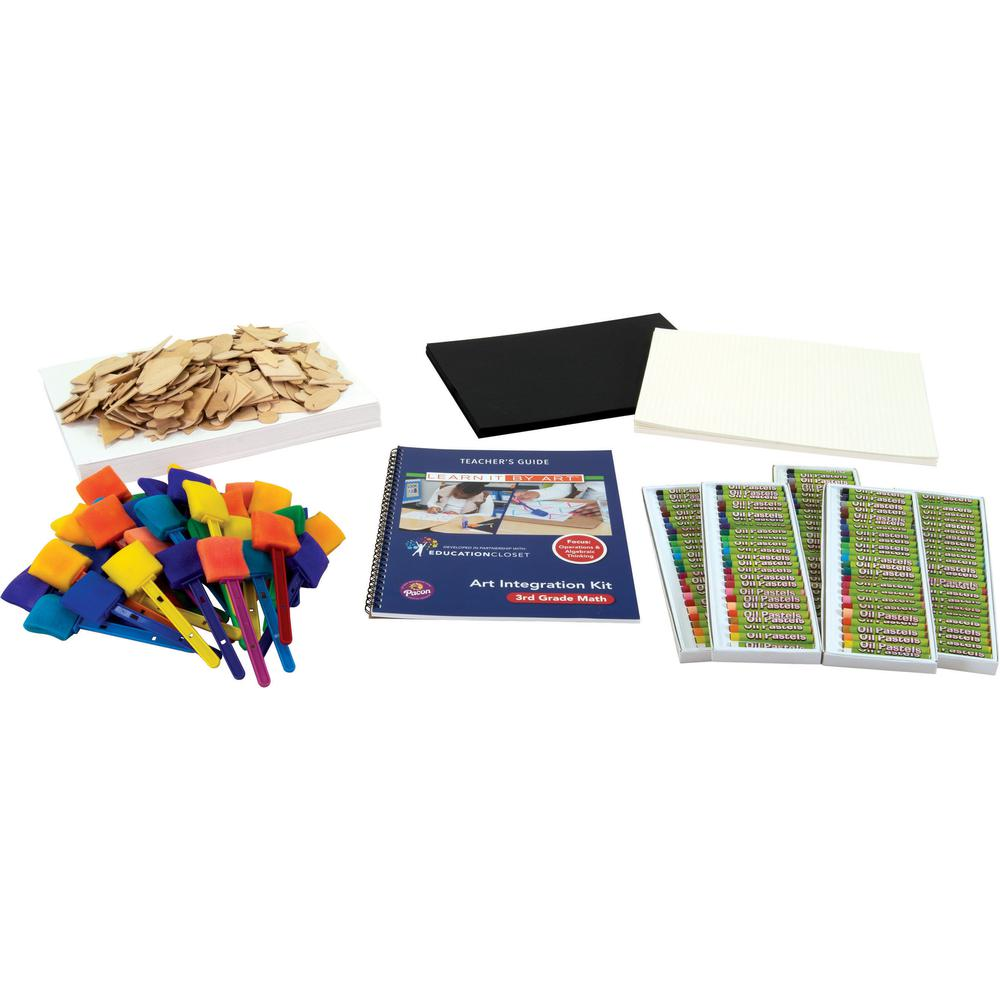
The Pacon® 3rd-Grade Math Art Integration Kit brings structure and creativity together to support deeper understanding of Operations and Algebraic Thinking. Designed for active classrooms and growing learners, this STEAM-based kit uses hands-on art projects to reinforce key third-grade math concepts in a way that feels engaging rather than overwhelming. With pre-prepped materials included, teachers can move directly into instruction without spending valuable time organizing supplies.
Developed alongside STEAM specialists at Education Closet, the kit provides everything needed to lead three complete lessons for up to 30 students. The teacher’s guide includes step-by-step lesson plans, pre- and post-assessments, differentiation strategies, and a curriculum map that helps extend art-integrated learning into future units. Materials such as heavyweight tagboard, gridded watercolor paper, oil pastels, watercolor wands, wood shapes, and black construction paper are selected to support visual reasoning, pattern work, and problem-solving through artistic expression.
Quick answers to the questions we hear most. Don't see yours? Reach out to the team.
The activities are structured around Operations and Algebraic Thinking, which are core focus areas in third grade. Students use visual composition and structured art exercises to explore patterns, relationships, and mathematical processes. By physically working with materials, they reinforce concepts that might otherwise feel abstract. The included assessments also help track progress before and after lessons.
The lessons are adaptable for both traditional classroom layouts and collaborative group settings. Since materials are pre-prepped, distribution is straightforward and minimizes disruption. Teachers can guide whole-class instruction or divide students into smaller working groups. The kit is designed to fit comfortably into a standard class period.
Some components, such as wood shapes or certain durable pieces, may be reused depending on how they are incorporated into projects. Consumable materials like paper and pastels are intended for the included lesson sessions. Many educators choose to save durable pieces for math centers or review activities later in the year. The curriculum map also offers ideas for extending use creatively.
No art background is necessary to successfully deliver the lessons. The guide breaks down each step clearly and includes practical teaching notes to build confidence. Video resources and access to an online community provide additional support if needed. This makes the kit accessible to educators who may be more comfortable teaching math than art.
When students visualize and construct math-based designs, they engage spatial reasoning and creative thinking alongside computation. This multi-sensory approach strengthens comprehension by connecting movement, color, and structure to numerical ideas. It also increases engagement, which often leads to stronger recall over time. For many learners, seeing math represented visually helps concepts make more lasting sense.