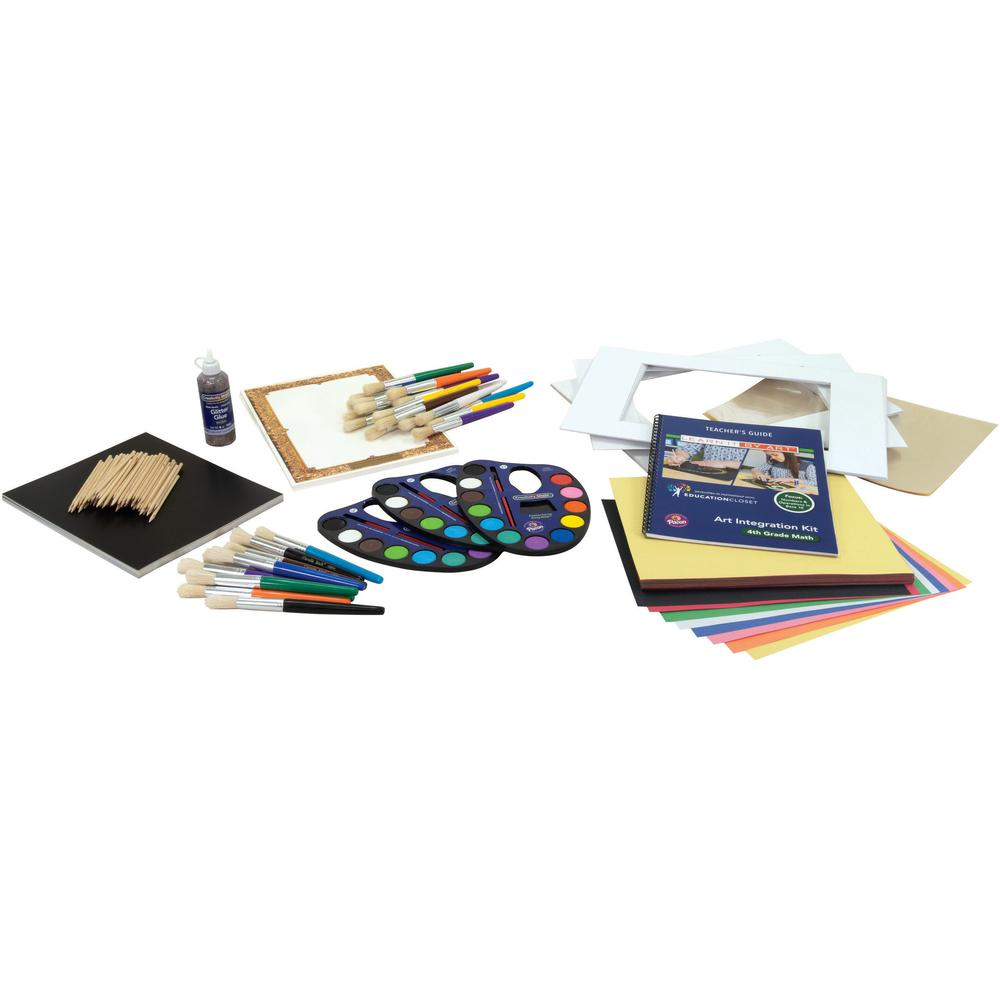
The Pacon® 4th-Grade Math Art Integration Kit supports deeper numerical understanding by combining structured math instruction with creative, hands-on projects. Centered around Numbers and Operations in Base 10, this STEAM-focused kit helps students visualize place value, numerical relationships, and multi-digit operations through guided artistic work. With materials prepared in advance, educators can step into lessons with confidence while keeping students actively involved from start to finish.
Developed alongside the STEAM education experts at Education Closet, the kit provides the framework to deliver three complete lessons for up to 30 students. The teacher’s guide includes detailed plans, pre- and post-assessments, differentiation strategies, and a curriculum map designed to extend arts integration across future instruction. Materials such as color splash art paper, watercolor paint sets, stubby brushes, glitter glue, mat frames, construction paper, clear cellophane sheets, wood sticks, and gold frame watercolor paper encourage layered creativity while reinforcing structured mathematical thinking.
Quick answers to the questions we hear most. Don't see yours? Reach out to the team.
The projects translate abstract numerical ideas into visual formats that students can build and manipulate. By organizing materials into structured designs, learners practice grouping, scaling, and recognizing value relationships. This physical interaction often strengthens comprehension compared to worksheet-only approaches. It also creates opportunities for discussion around strategy and reasoning.
The contents are portioned to support instruction for up to 30 students, making distribution straightforward for teachers. Pre-prepped materials reduce downtime and help maintain classroom focus during transitions. Because the lessons are structured, educators can guide the entire group while still allowing individual expression. This balance supports both consistency and creativity.
Yes, the variety of surfaces and mediums encourages students to experiment with layering, texture, framing, and color application. Elements like cellophane sheets and mat frames introduce dimension, while watercolor and glitter glue support more expressive finishes. These options help students explore artistic decisions while staying aligned with the lesson objectives. The result is work that reflects both math understanding and creative interpretation.
The included curriculum map makes it easier to align activities with broader math instruction throughout the year. Teachers can reference it when planning future units or reinforcing previously taught skills. This built-in guidance helps reduce the need for extensive supplemental planning. Many educators appreciate having a resource that supports continuity.
Many of the components are selected to withstand frequent handling while students work through multi-step projects. Papers are sturdy enough for painting and layering, and tools are sized for controlled use by elementary learners. Proper storage between sessions can help maintain material quality. Overall, the kit is designed with the realities of classroom activity in mind.