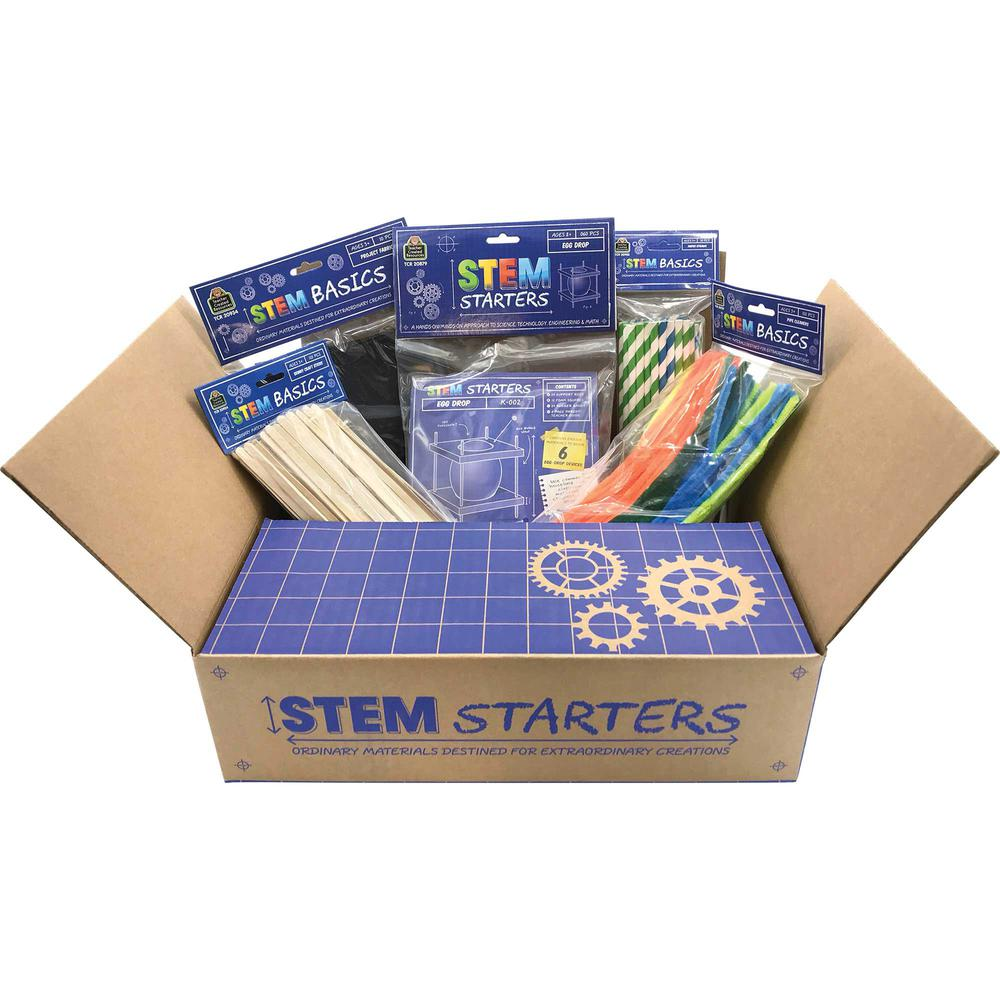
The Teacher Created Resources STEM Starters Activity Kit encourages curiosity-driven learning by giving students the tools to explore engineering concepts through creative problem-solving. Designed for hands-on experimentation, this kit supports the engineering design process, allowing learners to test ideas, adapt their approach, and build confidence through trial and discovery. It’s a practical choice for classrooms, homeschool environments, or activity groups looking to introduce structured STEM exploration without overcomplicating the setup.
Inside the kit, materials such as egg drop components, paper straws, skinny craft sticks, pipe cleaners, and project fabric provide a flexible foundation for imaginative builds. Students can approach challenges methodically while developing critical thinking skills that extend beyond a single activity. Suitable for individuals or small teams, the kit promotes collaboration, resilience, and creative exploration while keeping preparation straightforward for educators and group leaders.
Quick answers to the questions we hear most. Don't see yours? Reach out to the team.
The materials are intentionally versatile, allowing students to construct bridges, protective structures, simple prototypes, and other experimental designs. Open-ended components encourage learners to interpret challenges in their own way rather than follow a rigid template. This flexibility supports both guided instruction and independent exploration. Many educators use it to introduce foundational engineering concepts.
It can support both approaches depending on how it’s introduced. Teachers often frame a design challenge, while students use the materials to plan, test, and refine their solutions. The process naturally encourages observation and adjustment as projects develop. This balance helps maintain direction while leaving room for creativity.
The kit works well for individual learners but is especially effective in small-group settings where collaboration is encouraged. Teams can divide responsibilities such as planning, building, and testing. This dynamic often strengthens communication skills alongside technical thinking. Group sizes may vary depending on the complexity of the challenge.
Some components may be reused if projects are carefully disassembled after testing, while others are intended for single builds. Many instructors choose to incorporate leftover pieces into future design challenges. Storing materials properly can help preserve their condition. Over time, this can expand the range of possible projects.
Following a structured design cycle helps students view mistakes as part of learning rather than setbacks. As they brainstorm, build, and revise, they practice logical reasoning and adaptability. This approach often strengthens confidence because progress is measured through experimentation. It also introduces a mindset that supports long-term academic growth.